• Synaptic vesicles of cholinergic neurons are loaded with the neurotransmitter acetylcholine ( ACh+ )

  • The membrane of these synaptic vesicles contains an electrogenic H+−ATPase that pumps H+ into the vesicle , together with ACh+/H+-exchangers ( vAChT ) and Cl–/H+-exchangers ( CLC )

  • The coupling stoichiometry of the vAChT is one ACh+ exchanged for 2H+ , and of the CLC is 2 Cl– exchanged for 1 H+ , with the H+−ATPase hydrolyzing 1 ATP for 2H+ pumped

  • These vesicles exhibit a membrane potential Vsv=80 mV , inside positive , and a pH more acidic than cytoplasm by 1.5 units

  • Assume that the cytosol of the pre-synaptic terminal has the following properties :

    • [ACh+]intracellular=1 mM

    • [H+]intracellular=1 μM

    • [Cl−]intracellular=10 mM

  • You predict that the vesicular transporters constitute a secondarily active system maintaining a high vesicular [ ACh+ ]

  1. Draw a diagram of the synaptic vesicle that includes the transporters and indicates the relative rates for each that will achieve a steady-state Vsv and pHsv
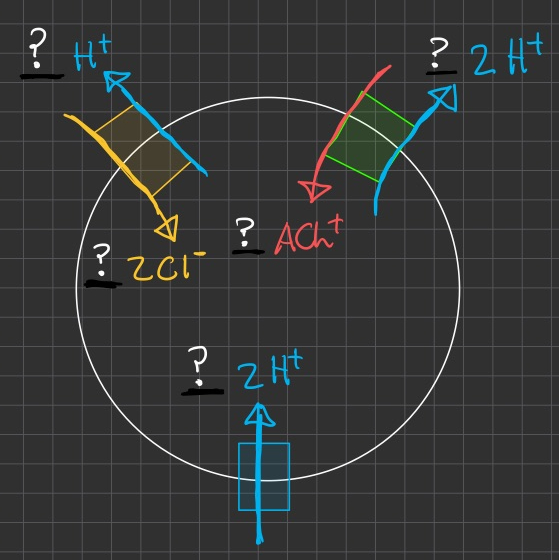
    image-20250312181032772

    • in order to know what "steady-state" looks like , we have to balance the stoichiometry numbers for all of the inputs and outputs

    • we don't need to worry about balancing ACh , because we want and expect it to accumulate in the synaptic vesicle

    • and since in our simplified model we don't have a way to export chloride , we want to then minimize the number of cycles that transporter

    • so lets just balance hydrogen :

      • at steady-state , we have more leaving ( 3 ) the cell than entering ( 2 )

      • if we run the ATPase 1.5 times instead of just once :

        1.5∗2=3 H+
      • so then inputs = 3 , and outputs = 3

      • but we can't run the ATPase half-way , its all or none.

      • double 1.5 to get the next whole number 3

      3∗2=6 H+
      • but now total hydrogen inputs = 6 , and total hydrogen outputs = 3

      • so make them also run an additional cycle
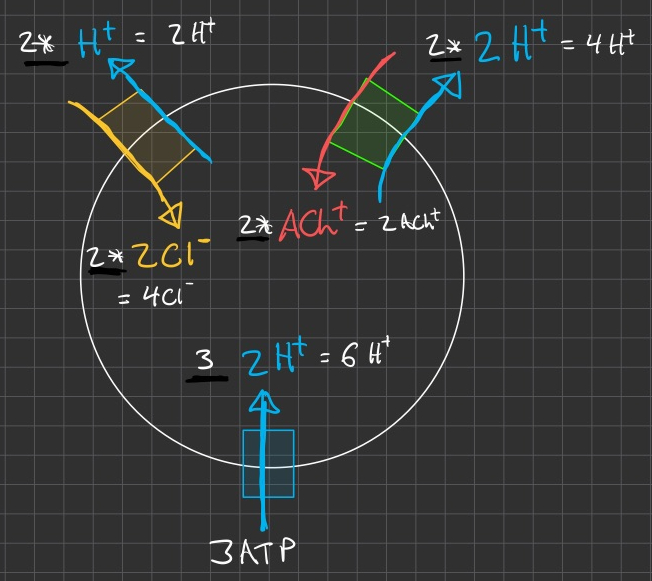
    image-20250312183648097

    • ok , but the charges are messed up and its not electrically neutral
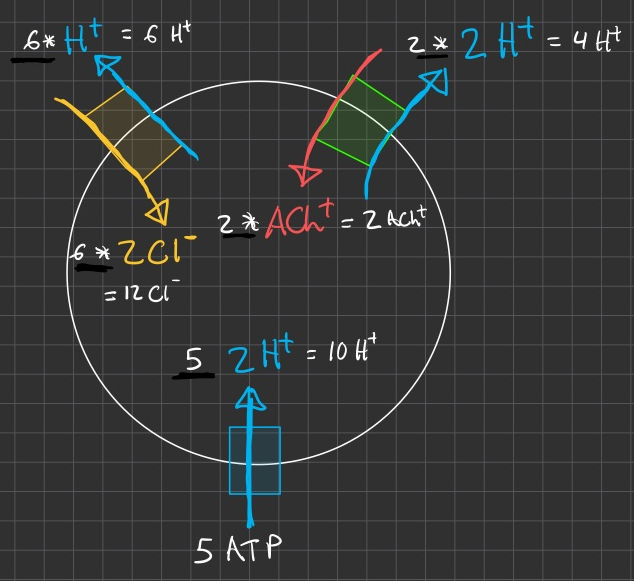
    Total Charge=(+6 from H+)+(+2 from ACh+)+(−4 from Cl−)
    Total Charge=+6+2−4=+4

    image-20250312185002725

    • now Vsv and pHsv are balanced

  2. You decide to calculate how high the vesicular [ ACh+ ] can reach with the available electrochemical gradients , EACh
    EACh=8.314 Joules1 Kelvin⋅mol∗( 37.0+274.15∘K )+1∗96484 JoulesVolts⋅mol∗ln( [ACh+]vesicle[ACh+]cytosol )
    EACh=8.314 Joules1 Kelvin⋅mol∗( 37.0+274.15∘K )+1∗96484 JoulesVolts⋅mol∗ln( [ACh+]vesicle1 mM )

    image-20250312194304249

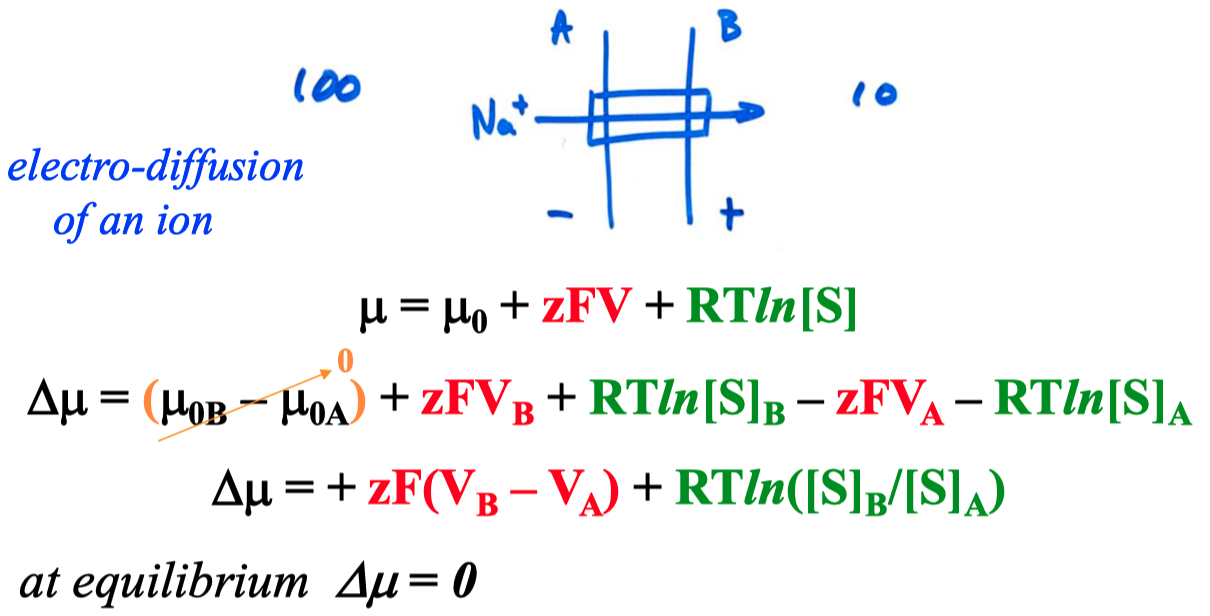
    μ=μ0+( z∗F∗V )+( R∗T∗ln( [X]inside[X]outside ) )
    • so we were given a pH difference instead of concentrations

      [H+]inside[H+]outside=10−ΔpH
    • and we also need the potential across the membrane ( Δμ ) , instead of just for one ion ( μ )

      ΔμX=μinside−μoutside
      ΔμH=( z∗F∗( ( Vinside−( Voutside ) ) ) )+( R∗T∗ln( 10−ΔpH ) )
    • we can simplify the natural log to :

      ΔμH=( z∗F∗( ( Vinside−( Voutside ) ) ) )+( R∗T∗ΔpH∗ln( 10 ) )
    • ok , but Vsv is defined as :

    Vsv=( Vvesicle )−( Vcytosol )
    • so , we have to flip the order of ΔV in the equation :

    ΔμH=( z∗F∗( ( Voutside−( Vinside ) ) ) )+( R∗T∗ΔpH∗ln( 10 ) )
    • being explicit :

      • Voutside=Vcytosol

      • Vinside=Vvesicle

      ΔμH=( z∗F∗( ( Vcytosol−( Vvesicle ) ) ) )+( R∗T∗ΔpH∗ln( 10 ) )
    • finally solving for ΔμH :

    ΔμH=( +1∗96484 JoulesVolts⋅mol∗( −80.0∗10−3 V ) )+( 8.314 Joules1 Kelvin⋅mol∗( 37.0+274.15∘K )∗( 1.5 )∗ln( 10 ) )
    =1216.119864864849291806203624 Joulesmol
    • but now we need ΔμACh

      • and its coupled to hydrogen in the vAChT transporter at 1 : 2 ratio

      ΔμACh=2∗ΔμH=2432.239729729698583612407248 Joulesmol
    • now we can plug this into the nersnt equation , and solve for the vesicular concentration of ACh :

    ΔμACh=R∗T∗ln( [ACh+]vesicle[ACh+]cytosol )
    2432.239729729698583612407248 Joulesmol=8.314 Joules1 Kelvin⋅mol∗( 37.0+274.15∘K )∗ln( [ACh+]vesicle1 mM )
    2432.239729729698583612407248 Joulesmol8.314 Joules1 Kelvin⋅mol∗( 37.0+274.15∘K )=ln( [ACh+]vesicle1 mM )
    e( 2432.239729729698583612407248 Joulesmol8.314 Joules1 Kelvin⋅mol∗( 37.0+274.15∘K ) )=e( ln( [ACh+]vesicle1 mM ) )
    e( 2432.239729729698583612407248 Joulesmol8.314 Joules1 Kelvin⋅mol∗( 37.0+274.15∘K ) )=[ACh+]vesicle1 mM
    e( 2432.239729729698583612407248 Joulesmol8.314 Joules1 Kelvin⋅mol∗( 37.0+274.15∘K ) )∗( 1.0 mM )=[ACh+]vesicle
    [ACh+]vesicle=2.560528421056074965246751589 mM

  • Changing the membrane electrical potential difference ( Vm ) requires separation of charges between the inside and outside of the cell

  • You predict that generating Vm=−60 mV for a large cell will require more charge separation than for a smaller cell

  • You also are curious about the amount of charge separation needed compared with the total number of charges inside of each cell

  1. Calculate how many charges you have to separate across the cell membrane to achieve Vm=−60 mV for a 10 μm diameter cell

    Q=C∗Vm
    # of elementary charges=Qe
    • e≈1.602∗10−19 C

    • Membrane Specific Capacitance = 1 μFcm2

    • Surface Area :

      A=π∗( 5∗10−6 meters )2=7.84540∗10−11 meters2
    • 1 m2=104 cm2

    A=7.84540∗10−11 meters2∗104 cm2m2=7.8540∗10−7 cm2
    • back to capacitance :

    C=( 1∗10−6 Fcm2 )∗( 7.8540∗10−7 cm2 )=7.8540∗10−13 F
    • total charge :

    Q=( 7.8540∗10−13 F )∗( 60∗10−3 V )=4.7124∗10−14 C
    • and finally , converting to number of elementary charges :

    # of elementary charges=4.7124∗10−14 C1.602∗10−19 C=2.9412∗105 charges
  2. Calculate how many charges likely are inside of this cell. Assume a 150 mM KCl solution inside of cell and a 150 mM NaCl solution outside of cell. ( 1cm3 = 1 milli-Liter = 10−3 Liter )

    • volume of a sphere :

    V=43∗π∗( 5∗10−6 m )3=5.2360∗10−16 m3
    V=5.2360∗10−16 m3∗1000 L1 m3=5.2360∗10−13 L
    • convert concentration of KCl to moles :

    moles of KCl=0.150 molL∗5.2360∗10−13 L=7.8540∗10−14 mol
    • now into total number of particles :

      7.8540∗10−14 mol∗6.022∗1023 particlesmol=4.7298∗1010 particles
    • but KCl breaks apart into K+ and Cl− , so van't Hoff factor = 2

    2∗4.7298∗1010 particles=9.4596∗1010 particles

  1. For synaptic vesicles 100 nm and 40 nm in diameter , you calculate how many charges have to be separated across the membrane to achieve Vsv=+60 mV

    • surface area of the 100 nm sphere :

      SA=4∗π∗( 50∗10−9 m )2=3.1416∗10−14 m2
      SA=3.1416∗10−14 m2∗104 cm2m2=3.1416∗10−10 cm2
    • capacitance :

      C=1∗10−6 Fcm2∗3.1416∗10−10 cm2=3.1416∗10−16 F
    • charge :

      Q=3.1416∗10−16 F∗( 60∗10−3 V )=1.8850∗10−17 C
    • number of charges :

      1.8850∗10−17 C1.602∗10−19 C=117.65 charges

    • now the same thing for 40 nm vesicle

    SA=4∗π∗( 20∗10−9 m )2=5.0265∗10−15 m2
    SA=5.0265∗10−15 m2∗104 cm2m2=5.0265∗10−11 cm2
    • capacitance :

      C=1∗10−6 Fcm2∗5.0265∗10−11 cm2=5.0265∗10−17 F
    • charge :

      Q=5.0265∗10−17 F∗( 60∗10−3 V )=3.0159∗10−18 C
    • number of charges :

      3.0159∗10−18 C1.602∗10−19 C=18.824 charges
  2. Calculate how many charges likely are inside of these synaptic vesicles

    • 100 nm :

      • volume :

        V=43∗π∗( 50∗10−9 m )3=5.2360∗10−22 m3
        V=5.2360∗10−22 m3∗1000 L1 m3=5.2360∗10−19 L
      • moles :

      moles of KCl=0.150 molL∗5.2360∗10−19 L=7.8540∗10−20 mol
      • total particles :

        7.8540∗10−20 mol∗6.022∗1023 particlesmol=4.7298∗104 particles
      • times 2 for van't Hoff factor :

        4.7298∗104 particles∗2=9.4596∗104 particles
    • 40 nm :

      • volume :

        V=43∗π∗( 20∗10−9 m )3=3.3510∗10−23 m3
        V=3.3510∗10−23 m3∗1000 L1 m3=3.3510∗10−20 L
      • moles :

        moles of KCl=0.150 molL∗3.3510∗10−20 L=5.0265∗10−21 mol
      • total particles :

        5.0265∗10−21 mol∗6.022∗1023 particlesmol=3027.1 particles
      • times 2 for van't Hoff factor :

        3027.1 particles∗2=6054.1 particles

Review Questions

  • Consider a system with two compartments separated by a rigid membrane that is freely permeable to water but impermeant to sucrose.
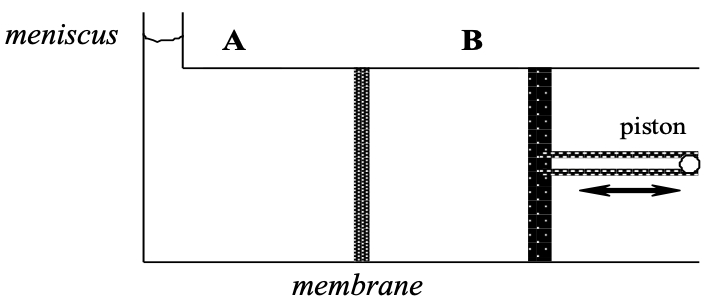
image-20250312171653406

  • Both compartments contain pure water and pressure is applied to the piston establishing a pressure difference , PB>PA , across the membrane

  1. Describe the relation between volume flow across the membrane and the hydrostatic pressure difference , PB−PA


  • No force is applied to the piston and 100mM sucrose is placed in compartment B.

  1. In what direction will the meniscus ( in compartment A ) move?

    • asdf

  2. What is the driving force for this volume flow?

    • asdf

  3. Adding NaCl ( also impermeant ) to what compartment could prevent volume displacement?

    • asdf

  4. What concentration of NaCl would have to be added to prevent volume displacement?

    • asdf

  5. What concentration of MgCl2 would prevent volume displacement?

    • asdf

  6. What pressure ( and orientation ) must be applied to the piston to prevent volume flow?

    • asdf


  • Consider the membrane permeable to glycerol , but less permeable to glycerol than to water

  • No force is applied to the piston and 100 mM glycerol is placed in compartment B

  1. How will the meniscus in the capillary of A move?

    • asdf

  2. How will the rate of movement compare with that observed when 100 mM sucrose was in compartment B?

    • asdf

  3. What pressure ( and orientation ) must be applied to the piston to prevent volume flow?